Semi‑precious stone slabs: lapis lazuli, agate, amethyst and the new luxury in stone
What they are, how they are made, why they cost what they cost and what to check before you buy. What we saw at Marmomac and what we explain to every client who asks us for them.
At Marmomac 2026 in Verona we saw it with our own eyes: among the marbles, granites and quartzites, the stands that stopped everyone were the semi-precious ones. Lapis lazuli, red, blue and green agate, amethyst, petrified wood. Whole slabs that look like enlarged jewels.
They are no longer a trade-show curiosity. These materials are making their way into luxury projects, hotels and high-end homes, but also, as we know firsthand, into the house of someone who wants to redo a special bathroom. The requests we get grow every month.
In this article we explain what they are, how they are made, why they cost what they cost and what to watch for before you buy.
What they really are
A semi-precious stone slab does not come out of a block, like marble. It is built by hand.
It starts with pieces of natural stone: slices of agate, amethyst crystals, fragments of lapis lazuli. Each piece is cut and polished one by one; then the pieces are laid out like a mosaic and bonded with resin onto a backing. In some slabs the joints are filled with gold or silver leaf.
The result is a unique material: every slab is different and the pattern never repeats. That is why, before you buy, we always send photos of the actual slabs.
Why they cost more than marble
If you take a piece of rough lapis lazuli to a jeweler, the stone itself is not worth a fortune. A slab's value comes from everything that happens after:
- Rarity. Almost all quality lapis lazuli comes from one mountain area in Afghanistan, where it has been mined for centuries in hard conditions, at high altitude and for only a few months a year. There are other deposits in Chile and Russia, but they are few.
- Selection. The pieces are chosen for color, purity and consistency. In lapis lazuli you look at the depth of the blue and the amount of white calcite and golden pyrite.
- Labor. Cutting, polishing and fitting hundreds of pieces into a 5 m² slab takes days of skilled work.
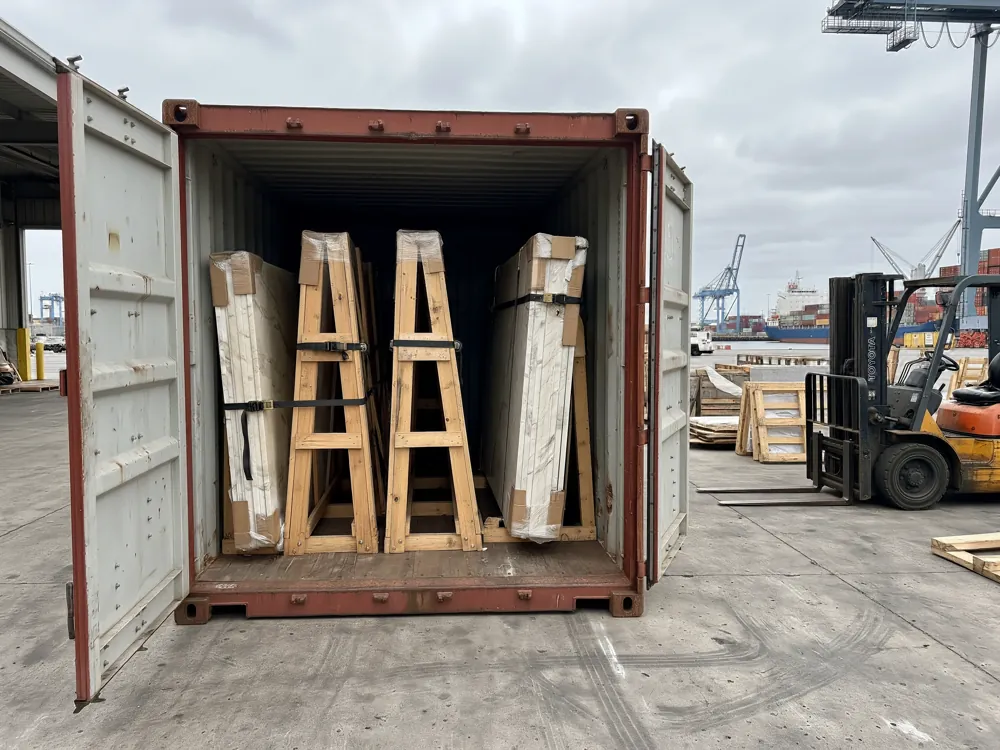
- Packing and shipping. These are delicate materials that travel in closed, reinforced crates. They cost more to ship and to insure.
To give a concrete idea: a lapis lazuli slab of about 5 m² that we quoted recently cost about 3,800 euros. That is the price of a rare material, worked by hand, piece by piece.
Beautiful in a different way
Marble conveys elegance, order and classicism. Semi-precious stones convey something else. They have a deep luster, an almost mineral depth, that shows above all up close. They are more primal materials: they remind you that they come from the earth, from millions of years of crystals growing in the dark.
Many people also give them a spiritual or energetic value: amethyst for calm, rose quartz for harmony, lapis lazuli for wisdom. These are ancient traditions, not scientific properties, but they are part of the appeal of these materials, and for many clients they matter.
One thing we can say for certain: they are worth seeing in person at least once in your life.
The stones in our catalog
Our catalog has 42 semi-precious stones in slabs. These are the main families and what makes each one special.
Lapis lazuli
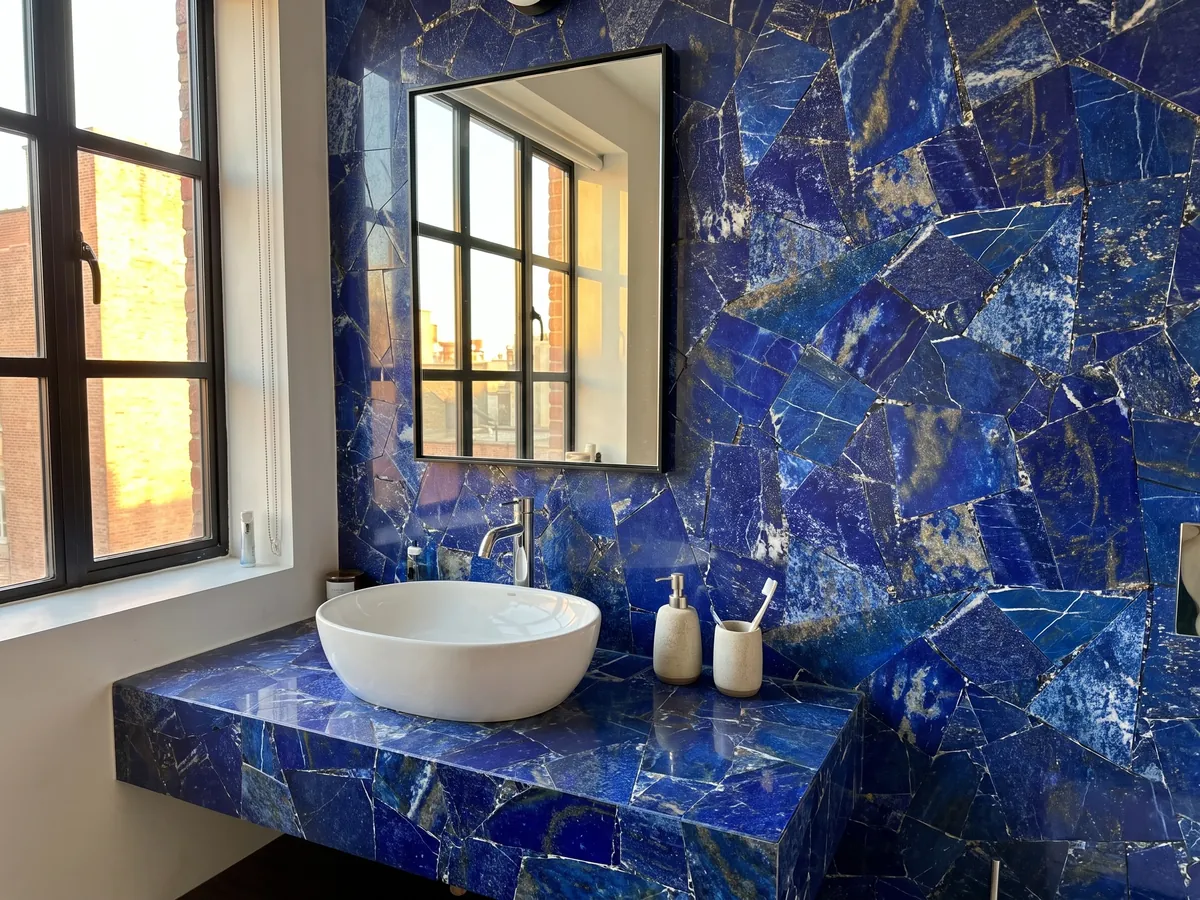
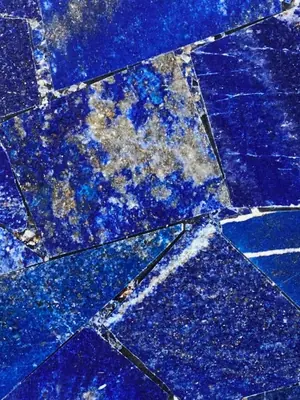
Deep ultramarine blue, with white flecks of calcite and golden specks of pyrite. For centuries it was ground to make the ultramarine blue of Renaissance painters: it cost more than gold. It is opaque, so it cannot be backlit, but it glows in the room's light. Ideal for accent walls, headboards and bathrooms. See lapis lazuli.
Agate
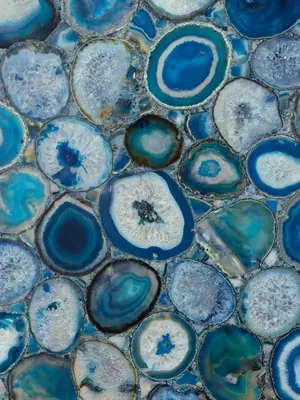
A variety of quartz that grows in concentric bands. Cut into slices, it shows rings and crystalline edges. In nature it is mostly gray, white, beige and brown. The blue, fuchsia, green and purple agates you see in so many slabs are almost always dyed. It is normal and stable practice when done well, but it should be said clearly. We always say it. The light areas let light through: backlit, an agate comes alive.
Amethyst
Amethyst is purple quartz: the color comes from traces of iron in the crystal. It comes mostly from Brazil and Uruguay. The slabs use whole crystals, with a three-dimensional effect. One important technical point: in strong sun amethyst can fade over time. It belongs indoors, away from direct light. Lit from behind, though, it is spectacular. See amethyst.
Quartz: white, rose, smoky and lemon
All are variants of the same mineral, one of the hardest in nature: 7 on the Mohs scale, harder than marble and granite. White quartz and rose are translucent and can be backlit. Smoky, a smoke gray, is one of the most elegant for dark interiors.
Tiger's eye
It has a silky sheen that moves as you change your angle, like a cat's eye. Gold, red or blue. It is opaque and lives on the room's light.
Labradorite
A dark gray stone that, in the right light, flashes blue, green and gold. This effect is called "labradorescence". It comes mostly from Madagascar. On a wall it changes color as you walk past. See labradorite.
Malachite
Green in concentric bands, from the Congo. It is a copper mineral: delicate, sensitive to acids and softer than quartz. Perfect for walls and small decorative surfaces, not for heavy-use areas. See malachite.
Sodalite and turquoise
Sodalite is a darker, deeper blue than lapis lazuli, with white veins. Turquoise is almost always stabilized with resin so it can be worked: that is normal, but here too it should be said.
Red jasper
An opaque, compact brick red, from India. It is one of the toughest semi-precious stones. See red jasper.
Petrified wood
Tree trunks from millions of years ago, in which the wood was slowly replaced by silica, that is, by quartz. You can still see the rings and the grain, but it is stone. It comes mostly from Indonesia and Madagascar. See petrified wood.
Fossil coral
Ancient corals turned to stone, with the pattern of the colonies still visible. See fossil coral.
Mother of pearl
It is not a stone but the inside of shells. It has iridescent, pearly reflections. Light and delicate, it is ideal for walls and furniture. See mother of pearl.
Selenite
White, silky and translucent, but it is crystallized gypsum: very soft (2 on the Mohs scale) and it cannot take water. Beautiful backlit on a dry wall, never in a bathroom near water. See selenite.
Where to use them and where not
The semi-precious stone itself is hard: quartz and agate reach 7 on the Mohs scale. The weak point is the resin that holds the pieces together: it scratches before the stone does and it cannot take heat.
Yes
- accent walls, with or without backlighting;
- bar and counter fronts;
- coffee tables and indoor furniture;
- vanities and bathroom walls, away from direct water spray;
- headboards, niches and decorative panels.
No
- floors: the resin scratches when you walk on it;
- outdoors: strong sun damages the resin and fades some stones;
- kitchen countertops by the stove and areas near heat sources.
Cleaning: a soft cloth and water. No solvents, no abrasive products, no hot pans set directly on it.
Backlighting: agate, amethyst, quartz and selenite let light through. They are fitted with LEDs behind the slab, which run cool and do not damage the resin. Lapis lazuli, tiger's eye, malachite and mother of pearl, on the other hand, are opaque.
Origin and customs
This is a point very few people know about, and it can be very costly.
Between Europe and many countries in the Americas there are trade agreements that reduce or remove the duty. But they apply only if the goods are of European origin and travel with the right certificate, such as the EUR.1.
The problem is that almost all semi-precious stones are mined outside Europe: Afghanistan, Brazil, Madagascar, the Congo, Indonesia, China, Iran. They are worked and assembled in Italy, but assembling them in Italy does not automatically make the slab of European origin. It depends on the rules of origin for that product and on how much work was done in Europe. In some cases the supplier can issue the EUR.1, in others not.
If the document is missing, you pay the full duty on arrival. On a material that costs thousands of euros per slab, the difference is a heavy blow.
That is why we check case by case, before the sale, whether a slab has origin documents and which ones. For some materials we can guarantee it, for others we cannot, and we say so up front. If you want to know how the rest of the import works, we explain it in how to import marble from Italy.
What to ask before you buy
If you are considering a semi-precious stone, these are the questions to ask any supplier:
- Can you send me a photo of the actual slab? Not of a similar slab: of the one that will arrive.
- Is the stone dyed, stabilized or natural? All three are fine, but you need to know.
- What backing is it mounted on? A solid backing makes the slab easier to install.
- Does it have origin documents? And can an EUR.1 be issued for my country?
- How does it travel? In a closed crate, insured, and with what insurance?
- Is there another one like it? If a slab breaks during installation, an identical one does not exist. Consider buying one extra.
In short
Semi-precious stone slabs are not marble, and they should not be treated like marble. They are rare materials, worked by hand, delicate to ship and to install. They cost more, and there is a reason.
But in the right place, a lapis lazuli wall or a backlit agate bar changes a space completely. No marble has the same effect.
Frequently asked questions
How is a semi-precious stone slab made?
By hand. The pieces of natural stone are cut and polished one by one, laid out like a mosaic and bonded with resin onto a backing. That is why every slab is different.
Can semi-precious stone be used on a floor?
No. The stone is hard, but the resin that holds the pieces together scratches when you walk on it. It does not go outdoors or near heat sources either.
Which semi-precious stones can be backlit?
Agate, amethyst, white and rose quartz and selenite let light through. Lapis lazuli, tiger's eye, malachite and mother of pearl are opaque.
Is colored agate natural?
In nature agate is mostly gray, white, beige and brown. Blue, fuchsia, green and purple agates are almost always dyed. It is normal and stable practice when done well, but the supplier has to tell you.
How do you clean a semi-precious stone slab?
With a soft cloth and water. No solvents, no abrasive products and no hot pans set directly on it.
Want to see them?
Our catalog has the 42 semi-precious stones we work with, with photos of real slabs. And if you are looking for something that is not there, write to us: we will find it.
 lapis lazuli
 blue agate
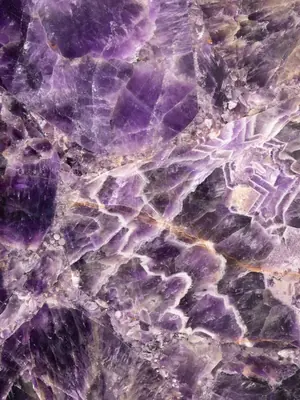 amethyst
Keep reading
- A container or a few slabs?How many m² fit in a container and when importing pays off.See more
- Who installs your marble?Who is responsible if a slab breaks and which adhesive to use.See more
- Quote checkSend us the quote you got and we will tell you if the price is fair where you are. If it is not, we find you a better option.See more