
Full container, half container or just a few slabs? How importing Italian marble really works
Importing a few slabs from Italy rarely pays off. But it is not impossible. Here we explain why, when it does pay off and how to do it without surprises.
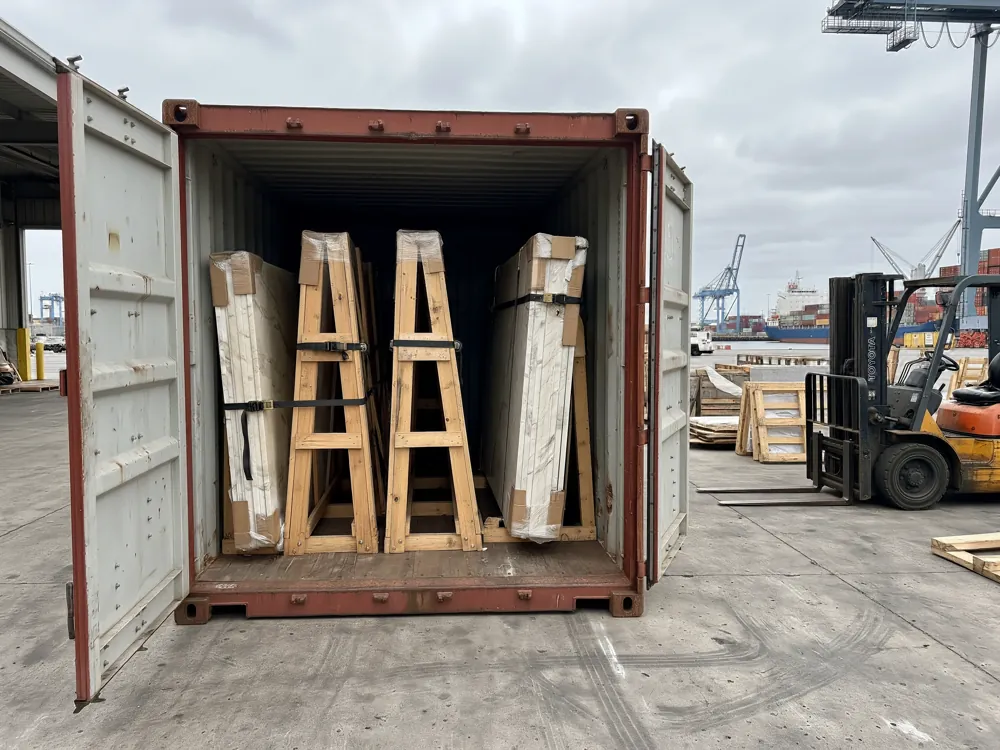
Every week we hear from Portugal, Brazil, Peru, Chile and Mexico. Often the order is 10, 12, 15 or 20 m². The honest answer is this: importing a few slabs from Italy usually does not pay off. But it is not impossible, and in this article we explain why, when it pays off and how to do it without bad surprises.
Marble is heavy, and weight decides everything
With marble, the limit is not the space inside the container: it is the weight.
- A 2 cm slab weighs about 54 kg per m².
- A 3 cm slab weighs about 80 kg per m².
- In practice a 20-foot container carries about 25 tonnes, A-frames included.
That means a container holds roughly 400 to 450 m² in 2 cm, or 280 to 300 m² in 3 cm. That is why marble almost always travels in 20-foot containers: a 40-foot one is bigger, but it can carry only a little more weight. The extra space would stay empty.
Why a few slabs cost so much
Shipping has many fixed costs: the truck to the port, export customs, port charges, documents and customs clearance on arrival. These costs are almost the same whether you ship 15 m² or 400.
In our experience, on a small order freight can reach about 58 USD per m², while in a full container it drops to about 10 USD per m². That is six times as much for the same material.
It is also about the price of the material: the more slabs you buy, the better the price the supplier gives you. It is the law of large numbers.
That is why importing really pays off from 200 to 250 m² up to a full container.
And if you need only a little?
We do not turn down small orders. We take them when it is possible and when it is good for the client. There are three ways.
1. Share a container
We look among our partners for someone already preparing a container to the same country, and we add the client's slabs to it. It works well, but you have to fit their timing: if the next container to Mexico leaves in one or two months, the client has to wait. If you want to know when one leaves with free space, sign up for shared-container alerts.
2. Consolidated freight (LCL)
There is also consolidated shipping: you pay only for the space you take, and other people's goods travel in the same container. On paper it is convenient. In practice, with marble we almost always advise against it, and we explain why in the next section.
3. Air freight
We have done it for small, valuable pieces: marble columns, custom pieces, one-off pieces. For slabs it is very rare. It can be done, because almost anything can be done today, but the price goes up a lot.
The problem with consolidated freight
With consolidated freight your slabs share the container with other people's goods: clothing, machinery, cardboard boxes. That means:
- More handling. The container is loaded and unloaded at intermediate warehouses, and every step is a chance for damage.
- Marble is the heaviest cargo. With a 25-tonne limit, slabs usually have to be loaded in a certain order, and it is not always the safest one for them.
- Someone else's forklift. If someone has to unload their goods before yours, one knock from a forklift is enough to ruin a slab.
These things happen; they are not hypotheticals. That is what transport insurance and reinforced packing are for. But with marble you have to be very careful about how it is done.
What you need to import well
If you decide to import, these are the things to be clear on before you pay:
- Packing. Slabs travel on wooden A-frames or in closed crates, well secured. If the packing is poor, no insurance gives you back the original slab.
- All-risk insurance. It covers the value of the goods plus the freight. Without it, we would not ship a single slab.
- Who pays for what (Incoterms). "Ex works" (EXW) means all the transport is yours from the warehouse in Italy. "FOB" means the supplier takes it as far as the ship. "CFR" or "CIF" means freight to your port is included. Knowing which one you are buying avoids surprises.
- Customs on arrival. Every country has its own taxes. Between Europe and many Latin American countries there are trade agreements that reduce or remove the duty, but only if the material is of European origin and travels with the right certificate (for example the EUR.1). Local VAT, on the other hand, is always paid.
- Timing. Allow a few weeks to prepare and load the slabs, plus about 3 to 6 weeks at sea depending on the country. If you are in a hurry, it is better to know from the start.
If you already have an import quote and are not sure it is put together right, we will check it for you.
A real example: lapis lazuli for Mexico
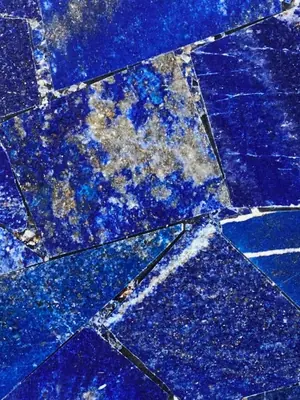
Recently a client in Mexico asked us for 3 slabs of lapis lazuli for a bathroom wall. It is a spectacular material: we saw it in person and it really leaves you speechless. It shows how far the world of stone is opening up, beyond marble, toward semi-precious stones.
The price was about 3,800 euros per slab. To arrive within a month it had to go by air. Then came customs, Mexican VAT and transport to the house. In the end the total rose a long way above the price of the slabs. Inside a container it would have cost much less, perhaps together with Carrara or other materials from the same supplier. But for a private client with a single wall to do, a container makes no sense.
We do not like a client going away empty-handed. But we prefer to tell them the truth up front rather than let them discover the costs later.
The advice nobody follows anymore: buy 10 to 15% extra
In the past, when an architect or engineer had a project, they always bought 10 to 15% extra from the same lot. Today, in our experience, it happens less and less.
That is a mistake. If a slab breaks in transit or during installation, there is no spare. The lot is gone, the bookmatch no longer lines up, and if the material is rare you may never find it again. We also cover this in the article on installation.
Large residential developments still do it, because nobody there can afford to invest that much without a spare. We always recommend it, on small projects too.
"Italy is too expensive": is it true?
In recent years Italy is often ruled out because people think its prices are sky-high. That is not so. Italy has the most iconic materials in the world, and quality costs money, as with everything.
A good-looking car and a good car do not cost the same. A great Italian or French wine does not cost what a table wine does. The same goes for olive oil or for meat: behind the price there is more attention, more care and more control.
Stone is the same, and you can see it in the structure of the material: more compact crystals, less porosity, fewer fissures, more even color and veining. That is why there are different grades: first choice, commercial and sometimes a lower one too. Two slabs with the same name can cost twice as much as each other, and there is usually a reason.
Our job is to explain it clearly, so the client chooses knowing what they are buying.
In short
- Under 50 m²: it almost always makes more sense to buy in your own country, or to wait for a shared container.
- Between 50 and 200 m²: we look at each case, sharing the container with others.
- Over 200 to 250 m²: direct import really pays off, and the more material you bring, the lower the price.
- Always: same lot, 10 to 15% extra, serious packing, insurance and the customs numbers worked out in advance.
Frequently asked questions
How many m² of marble fit in a container?
A 20-foot container holds about 400 to 450 m² of 2 cm slabs, or about 280 to 300 m² of 3 cm slabs. The limit is weight, about 25 tonnes including the A-frames, not space.
How much does a m² of marble weigh?
A 2 cm slab weighs about 54 kg per m², and a 3 cm slab about 80 kg per m².
Is it worth importing marble from Italy for a small area?
Almost never below 50 m²: the fixed costs of shipping make the freight per m² several times that of a full container. Direct import really pays off from about 200 to 250 m². Between 50 and 200 m² we look at each case and share the container with others.
What is a shared container?
It means adding your slabs to a container another client is already preparing for your country. You pay less freight, but you ship when that container ships.
How long does marble from Italy take to arrive?
A few weeks to prepare and load the slabs, plus about 3 to 6 weeks at sea depending on the country.
Weighing up an import?
Write to us with the material, the m² and the destination country. We will tell you honestly whether it makes sense and how to do it.
The stones in this guide
 Carrara
 lapis lazuli
 Calacatta
Keep reading
- How much does marble cost?Which stones cost more, what changes the price per m² and what to send for a quote.See more
- Shipping and importingHow stone travels from the producer's yard to your site, and which countries we ship to.See more
- Quote checkSend us the quote you got and we will tell you if the price is fair where you are. If it is not, we find you a better option.See more